You know what you feel. That part is not the problem.
The problem is that every time you try to say it, something happens. The words come out smaller than the actual thing. Or they don’t come at all. Or they arrive wrong, too formal, too generic, not the right version, and so you say something easier instead.
And then the moment passes.
And the feeling stays inside you, the same size it always was, with no way out.
If that sounds familiar, this page is for you.
Not for people who don’t feel things. For people who feel things very deeply and cannot figure out how to let them out in a way that matches how big the feeling actually is.
That is a specific, real, common struggle. And it has nothing to do with how much you care.
👉 Let’s start with why it happens. Because understanding that changes everything.
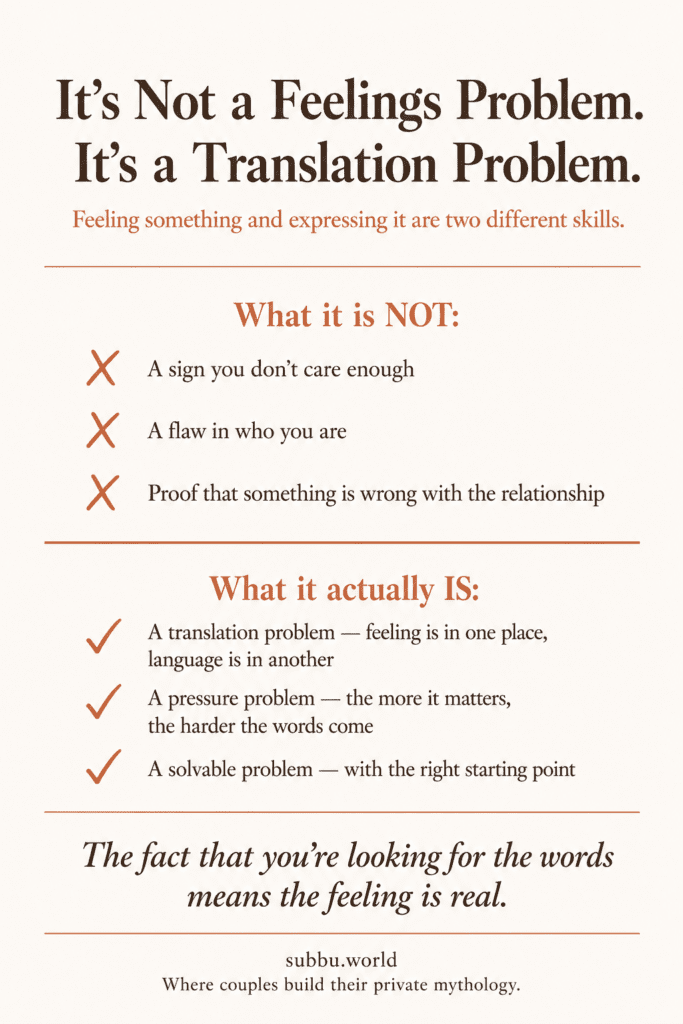
You Are Not Bad at Feelings. You Are Bad at the Translation.
Here is something that nobody explains clearly enough.
Feeling something and expressing something are two completely different skills.
You can be extraordinary at the first one and terrible at the second one. At the same time. In the same moment. With the same person.
The feeling lives in one part of you. The language lives in another. And moving something from one place to the other, especially when it matters, especially when the person is right in front of you, is genuinely hard.
It is not a character flaw.
It is not proof that you do not love them enough.
It is not a sign that something is wrong with you or with
the relationship.
It is a translation problem.
And translation problems have solutions.
The fact that you are here, looking for the words, means the feeling is real. The feeling was never the question. The question was always just how to get it out.
That is what this page is for.
Why It Gets Harder When It Matters More
Here is something that feels backwards but is completely true. The more a feeling matters, the harder it is to say.
Small feelings come out easily. “I’m annoyed.” “I’m tired.” “I’m happy about that.” These are simple. They do not require
much from you.
But big feelings, the ones that have weight, the ones that involve someone you love, the ones where getting it wrong actually matters — those are the ones that get stuck.
And the reason is pressure.
When you are about to say something important to someone important to you, part of your brain starts managing the situation in real time. Watching their face. Gauging their reaction. Editing what you were going to say before it even leaves you.
That editing of the surveillance of the moment is what kills the words.
The feeling was fine. The feeling was there and ready. It was the surveillance that broke the translation.
This is why some people find it easier to write things than say them. Writing removes the surveillance. Nobody is watching while you look for the words. You get the whole brain back. And when you have the whole brain, the words usually come.
This is also why the feeling often comes out later in the car, in the shower, lying awake at 2 am, when the pressure of the moment is gone, and the translation has space to happen.
The feeling was never absent. It just needed the pressure to leave first.
The 6 Real Reasons You Can’t Find the Words
Not one reason. Usually, a combination of a few.
Knowing which ones are yours changes how you approach this.
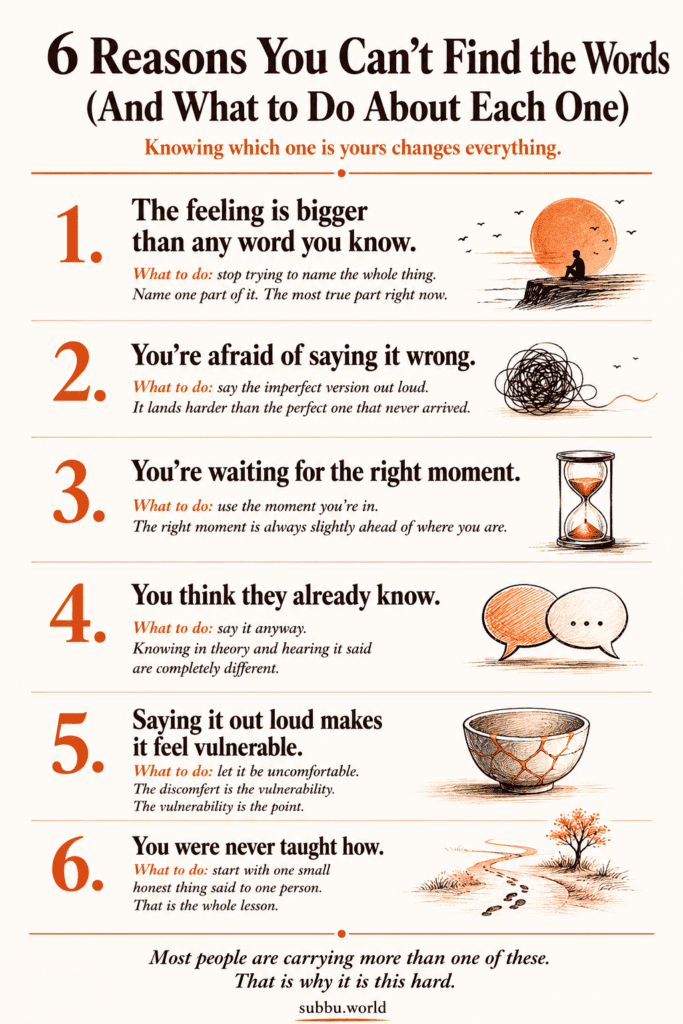
1. The feeling is bigger than any word you know.
Some feelings do not have precise language. The specific version of love you feel for this specific person, in this specific moment, after this specific year together, that version may genuinely not have a word.
This is not a failure of vocabulary. It is a feature of feeling. The most important ones resist easy language.
What to do: stop trying to name the whole thing. Name one part of it. The part that is most true right now. That part is almost always findable.
2. You are afraid of saying it wrong.
So you say nothing instead.
The fear of the imperfect version is what keeps the real version from ever arriving. And this happens most with the people who matter most, because with them, getting it wrong feels like losing something.
What to do: say the imperfect version. Out loud. Because the imperfect version, said honestly, lands harder than the perfect version that never arrived.
3. You are waiting for the right moment.
And the right moment keeps not coming.
There is a specific kind of anniversary. A specific quiet evening. A specific version of the conversation where everything is perfectly set up for the words to come out right.
That version never arrives. Because it does not exist. The right moment is always just slightly ahead of where you are.
What to do: use the moment you are in. Not the ideal version. The real one. The words said in the imperfect moment are always better than the words held for the perfect one.
4. You think they already know.
So you stop before you start.
“They know I love them.” “They know I’m grateful.”
“They know what they mean to me.”
Maybe. But knowing something in theory and hearing it said out loud are completely different experiences. People need to hear the thing, not just sense that it might be true.
What to do: say it anyway. Even if you think they know. Especially if you think they know.
5. Saying it out loud makes it real in a way that feels vulnerable.
And vulnerable is uncomfortable.
When something stays inside you, you are the only one who knows how big it is. The moment you say it, the other person knows too. And that is exposure. Real, uncomfortable, necessary exposure.
What to do: let it be uncomfortable.
The discomfort is the vulnerability.
The vulnerability is the intimacy.
The intimacy is the whole point.
6. You have never been taught how.
Most people were not taught to express feelings.
They were taught to manage feelings. To be reasonable. To not make things bigger than they are. To be fine.
Nobody taught them what to do with the big, real, specific feelings that do not fit neatly into any of those boxes.
What to do: start learning now.
With one small, specific, honest thing said to one person who matters. That is the whole lesson.
How to Start When Nothing Is Coming
Not a list of tips. Not a step-by-step system.
Just three things that actually work for most people most of the time.
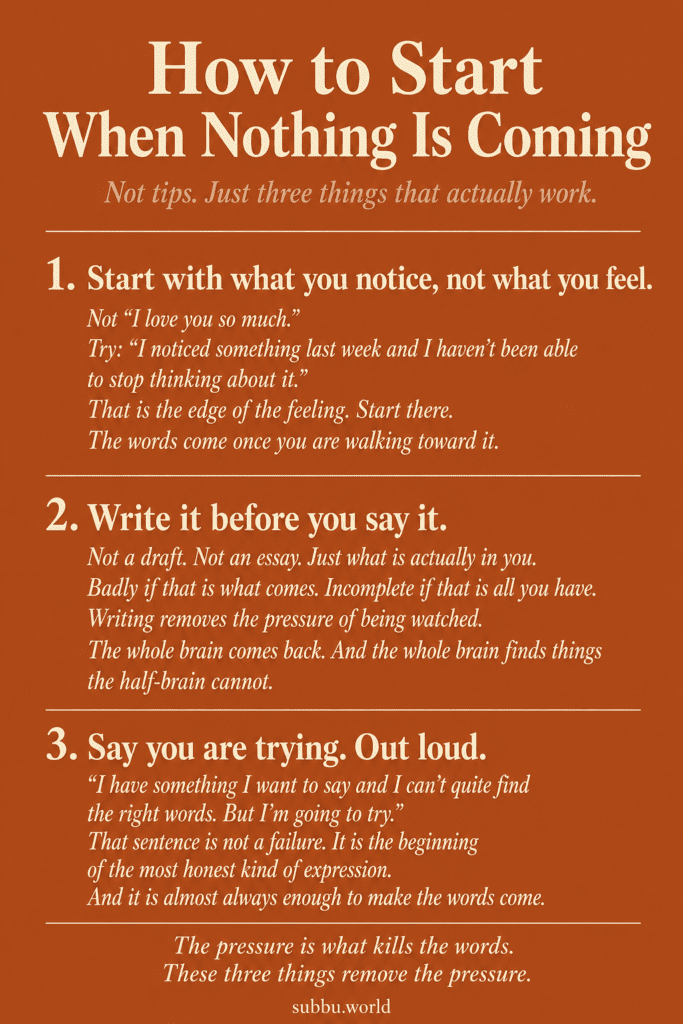
Start with what you notice, not what you feel
This sounds backwards. It is not.
When the feeling is too big to reach directly, go to the evidence of it first.
Not “I love you so much.”
Not “you mean everything to me.”
Try: “I noticed something last week, and I haven’t been able to stop thinking about it.”
That is the edge of the feeling. Not the feeling itself. But the evidence of it. The thing you noticed because of it.
Starting at the evidence walks you toward the centre. And once you are walking, the words usually start coming.
Write it before you say it
Not a draft. Not an essay. Not something polished.
Just what is actually in you. Badly if that is what comes. Incomplete if that is all you have. In fragments, if that is what exists.
Writing removes the surveillance. No one is watching while you look for the words. The whole brain comes back. And the whole brain finds things the half-brain cannot.
Once it exists on a page, even broken, even wrong, you have something. You found it. Now you just decide what to do with it.
Sometimes you send exactly what you wrote. Sometimes you find one sentence inside it that is the real thing, and you say just that. Sometimes, writing it is enough on its own.
All three are valid. All three are better than silence.
Say you are trying
Out loud. To them.
“I have something I want to say, and I can’t quite find the right words for it. But I’m going to try.”
That sentence is not a failure of expression. That sentence is the beginning of the most honest kind.
It lowers the temperature for both of you.
It says: I am not performing. I am actually trying.
It gives the other person something to receive while you keep looking for the words.
And it is almost always enough to make the words come. Because the pressure is gone. Because now they know you are trying. And trying, said out loud, is already a version of the thing you were trying to say.
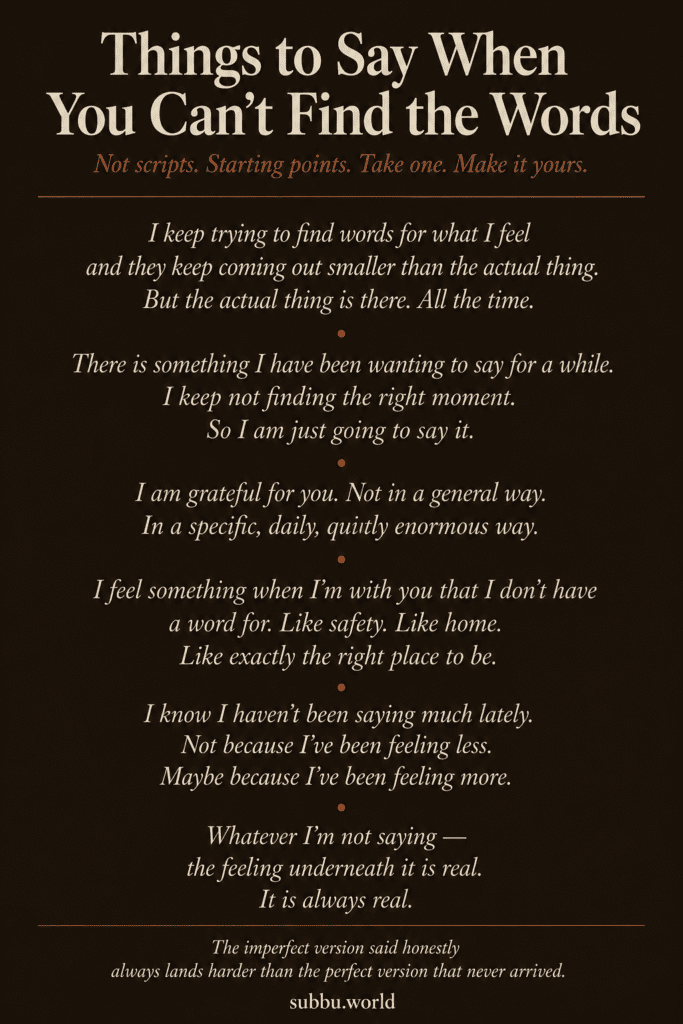
Things to Say When You Can’t Find the Words
Sometimes you do not need to find the words from scratch.
You just need a version that is close enough to true that you can make it yours.
These are not scripts. They are starting points. Take one. Change whatever does not fit. Say the version that sounds most like you.
When you want to say I love you but it feels too small:
“I keep trying to find words for what I feel, and they keep coming out smaller than the actual thing. But the actual thing is there. All the time. I just wanted you to know.”
When you have been meaning to say something:
“There is something I have been wanting to say to you for a while. I keep not finding the right moment. I think the truth is that there is no right moment.
So I am just going to say it.”
And then say it. Even imperfectly.
When you are grateful and cannot explain why:
“I don’t know exactly how to say this, but I am really grateful for you. Not in a general way. In a specific, daily, quietly enormous way. I wanted you to know that.”
When you feel something but cannot name it:
“I feel something when I’m with you that I don’t have a word for. Something like safety. Something like home. Something like the feeling of exactly the right place to be. I don’t know what to call it. But it’s there.”
When you have been distant and want to close the gap:
“I know I haven’t been saying much lately. Not because I’ve been feeling less. Maybe because I’ve been feeling more and didn’t know what to do with it. I’m trying to say it now.”
When the feeling is too big to land in one sentence:
“I have something to say, and I don’t think I can say all of it right now. But I can say part of it. The part that is most true right now is this:”
And then say the part.
When you just need them to know:
“I know I don’t always say the right things. But I want you to know that whatever I’m not saying, the feeling underneath it is real. It is always real.”
👉 If none of these feels right, or if the thing you need to say is too specific, too layered, too important to risk with any starting point, that is what the next section is for.
When You Have Tried Everything and the Words Still Will Not Come
Sometimes it is not about method.
You have tried to say it out loud. It came out wrong.
You tried to write it. Nothing arrived that felt like the real thing.
You have held the feeling for weeks, sometimes months.
And it is still there. Unchanged. Unsaid.
This is a specific kind of stuck.
Not the stuck of not feeling enough.
Not the stuck of not caring enough to try.
The stuck of caring so much that nothing you produce feels adequate to what is inside you.
I don’t know why some feelings resist language so completely.
Maybe it is because they are too close. Too important.
Maybe the stakes are too high, and the brain goes into protection mode and locks the door.
Maybe the words do not exist yet for this exact version of this exact feeling.
Whatever the reason, this is real. And it is not a failure.
But here is what is also true.
The person on the other side of that feeling, the one you are trying to say this thing to, does not need the perfect version.
They need any version.
The trying version. The not-quite-right version.
The I wrote this three times, and this is the closest I got version.
The I do not know how to say this, but I am going to try version.
Any of those is enough.
More than enough.
Because the trying itself says the thing. It says: You are worth my full effort to find the words. And that is, in the end, what most people most want to hear.
When You Want It Shaped Into Something Beautiful
And then there is this.
The thing you feel is real. You know it is real. You have tried to find the words, and what comes out does not match the size of what is inside you.
Not because you are bad at expressing yourself. Because what you feel is too specific, too personal, too exactly the shape of this relationship to fit inside ordinary language.
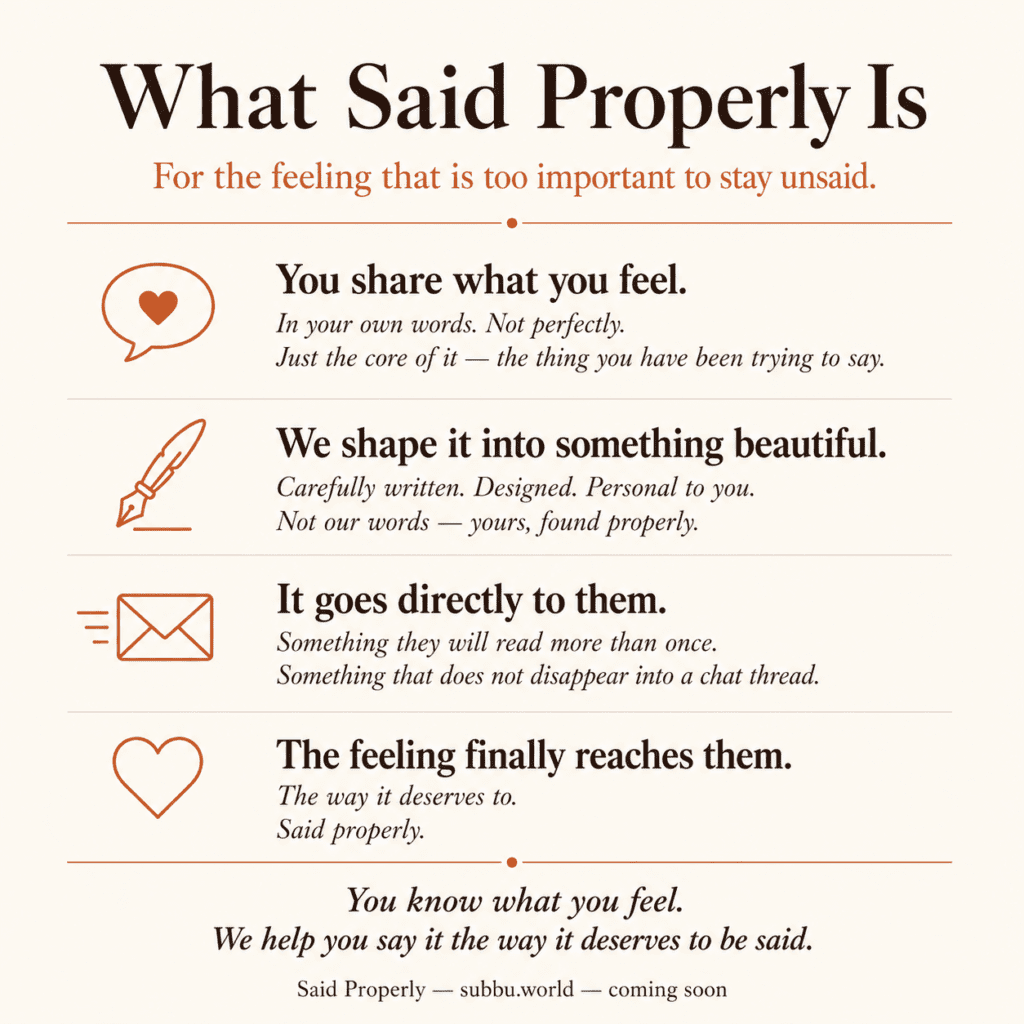
That is what Said Properly is for.
You tell us what you feel. Not perfectly. Not in the right words, there are no right words yet, that is why you are here. Just the core of it. The feeling underneath the silence. The thing you have been trying to say.
We shape it into something beautiful. Designed. Personal. Sent directly to them.
Not our words. Yours, found properly.
Something they will read more than once.
Something that does not disappear into a conversation thread.
Something that says it the way it deserves to be said.
The feeling has been inside you long enough.
It is time for it to reach them.
[Join the Said Properly waitlist →]
You Are Not the Only One
Most people have something they are not saying.
Not because they do not feel it. Because they cannot find the version of it that matches how real, specific and important it actually is.
And so it stays there.
Inside two people who are close enough to feel it but not yet say it to each other.
I don’t know why this is so common. Maybe because we are never taught this particular skill. Maybe because vulnerability still feels like risk
even in the safest relationships. Maybe because the feeling has been there so long, it has started to feel like furniture. Still there, just not noticed anymore.
But it is noticed. It is always noticed. By the person who feels it. At 2 am, in the car, in the middle of an ordinary Wednesday, when something happens, and they think: I should say that to them.
And then don’t.
If you have been carrying something like that, something you have been meaning to say, something you felt and held and never quite let out, say it.
Not tomorrow. Not when the moment is right.
Today. With whatever words you currently have.
Which are better than you think they are.
👉 And if you want help, if the thing you need to say deserves more than a text, more than a card, more than whatever imperfect version you keep arriving at
[Said Properly — join the waitlist →]
Explore More
→ How to Put Your Feelings Into Words
→ Things to Say to Someone You Love
→ Things to Say to Your Partner
→ Deep Questions for Couples
→ Bonding Activities for Couples
→ Open When You Can’t Say It
FAQs
Why can’t I find the words to express my feelings?
Because feeling something and expressing something are two different skills. The feeling lives in one part of you. Language lives in another. Moving something from one place to the other gets harder when the feeling is bigger and when the person matters more. This is a translation problem, not a character flaw, and not a sign that you do not care enough.
How do you express feelings when words don’t come?
Start at the edge of the feeling rather than the centre. Find something you noticed in a specific moment or behaviour rather than reaching for the whole feeling at once. Write it before you say it. Saying you are trying out loud. Any of these removes the pressure that is blocking the words in the first place.
Why is it so hard to express feelings to your partner?
Because the stakes are higher with the people who matter most. The brain starts managing the moment in real time, watching reactions, editing what you were going to say, and trying not to get it wrong. That surveillance kills the words. The feeling was always there. The pressure is what breaks the translation.
What do you say when you can’t express your feelings?
Say that. Exactly that. “I have something I want to say, and I cannot quite find the right words for it. But I am going to try.” That sentence removes the pressure for both of you and almost always lets the words follow. The trying said out loud is already a version of the thing you were trying to say.
Is it normal to struggle to express feelings in a relationship?
Completely normal. Most people feel things they cannot express at some point in a relationship, especially in the moments that matter most. It does not mean the feeling is less real. It means the gap between feeling and language is wide for this particular thing. That gap is closeable.
What is Said Properly?
Said Properly is a service from Subbu World for feelings that deserve more than silence. You share what you feel in your own words imperfectly, incompletely, just the core of it, and it is shaped into something beautifully designed and sent directly to the person you want to reach. Not someone else’s words. Yours, found properly. Joining the waitlist is free.
How do you tell someone how you feel when words fail?
Write it first. Even badly. Even in fragments. Writing removes the performance of speaking; no one is watching, no reaction to manage, the whole brain can focus on finding the words. Once you have found it on paper, you can decide whether to send it, say it, or use one sentence from it as your starting point. Any of those is better than continued silence.