
You know what you feel. That is not the problem.
The problem is that what you feel is big and what comes out is small. Or nothing. You open your mouth, and the words that arrive are not the right ones, so you say something else instead. Something easier. Something that doesn’t actually say it.
And then the moment passes. This happens more than people admit. Not just once. Over and over, in relationships that matter, with people who deserve to hear the
real thing.
This page is for that gap. The space between feeling something and finding the words to say it. Not a guide. Not steps. Just an honest look at why it happens and what actually helps.
👉 And if you get to the end and still feel stuck, there is something we built for exactly this.
Why Putting Feelings Into Words Is So Hard
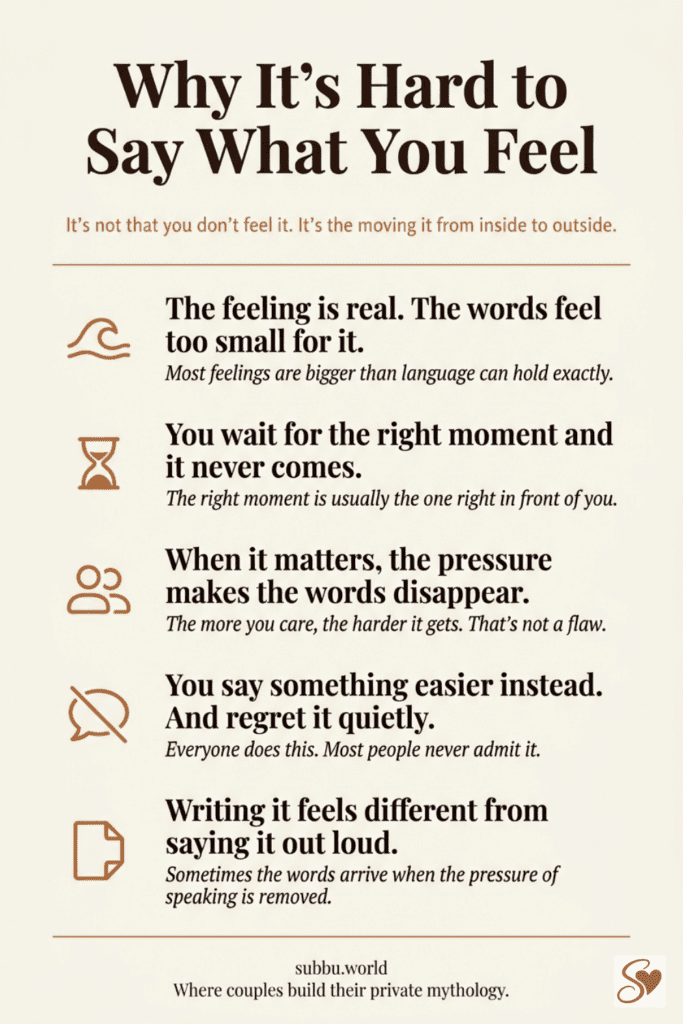
Here is something nobody really explains. The feeling and the words are not the same thing.
You can feel something completely and still not be able to say it. Not because you are bad with words. Not because you do not care enough. But because the feeling lives in one place in you, and language lives in another, moving something from one place to the other is harder than it looks.
Especially when the feeling is big. Especially when the person matters.
There is a specific kind of pressure that comes from trying to say something important to someone you love. Like, suddenly every word you know sounds wrong. Too small. Too formal. Too much like something someone else would say.
So you wait for the right moment. And the right moment never really arrives.
I don’t know if this sounds familiar. But I think it does. Because the people who end up searching for “how to put your feelings into words” are not people who don’t feel things. They are people who feel things very deeply and are trying to figure out how to let that out without it being less than what it actually is.
That matters. The fact that you’re trying matters.
The Thing Nobody Tells You About Expressing Feelings
You do not have to say it perfectly.
I think a lot of people are waiting for the version of themselves that can say it perfectly. The right words in the right order at the right time. Clean. Complete. No stumbling.
That version is not coming.
And honestly, the imperfect version, the slightly halting, not quite right, trying version, that one lands harder. Because it is real. Because the other person can hear that you are trying. And trying says something that perfect does not.
Most of the things that stay with people in relationships are not the polished speeches. They are the small things said badly.
“I don’t know how to say this, but I want you to know that I…” and then whatever came next.
The wanting to say it is already almost the whole thing. So the question is not how to say it perfectly. The question is how to start.
How to Actually Start Putting Your Feelings Into Words
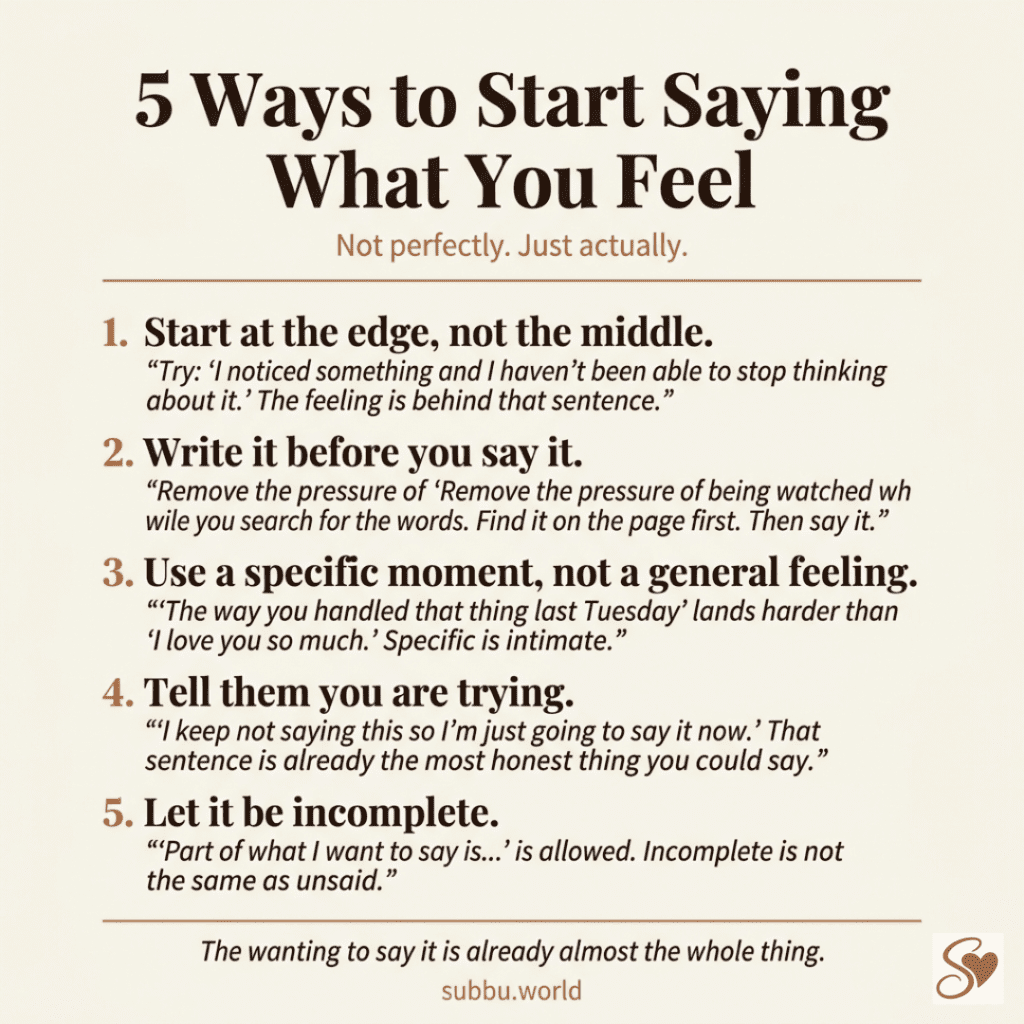
Start with what you know, not what you feel
This sounds backwards. But it works.
When the feeling is too big to reach directly, go to the edge of it first. Not “I love you so much it’s hard to explain.” That is reaching for the thing and missing.
Try: “I noticed something last week, and I haven’t been able to stop thinking about it.”
That is the edge. The feeling is behind it. Starting at the edge is how you walk toward the middle.
Write it before you say it
Not because writing is better than speaking. But because writing removes the pressure of the other person watching you look for the words.
When you write it down first, even badly, even in fragments, you are not performing. You are just finding it.
And once you have found it on the page, saying it out loud becomes a different thing. You already know it exists. You just have to let someone else in on it.
Use a specific moment instead of a general feeling
“I love you” is a general feeling.
“The way you handled that thing last Tuesday and didn’t make
it a bigger thing than it needed to be” is a specific moment.
Specific moments land differently.
They say: I was paying attention. And being told someone was paying attention is one of the most intimate things a person can experience.
When you cannot find the words for the feeling, find the moment where you felt it most clearly. Describe the moment. The feeling comes through in the description.
Say you are trying
Out loud.
“I have been trying to find the right way to say this, and I keep not saying it, so I’m just going to say it now.”
That sentence is not a failure of expression. That sentence is the beginning of the most honest kind of expression. It lowers the temperature. It creates safety. It lets the other person meet you where you are instead of waiting for you to arrive somewhere better.
Let it be incomplete
Not every feeling needs to be fully said in one go.
“I think I’ve been wanting to tell you something for a while, and I don’t quite have all of it yet. But part of it is…”
That is allowed. That is real.
Incomplete is not the same as unsaid. Incomplete means you started. And starting is the hardest part.
Things to Say When the Words Feel Too Small
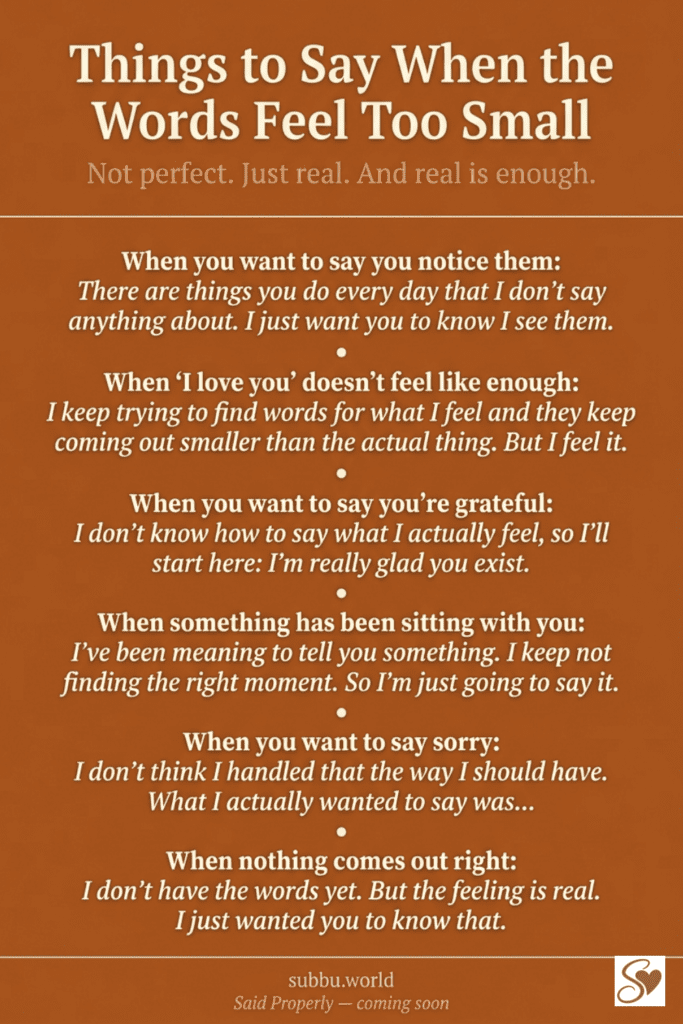
Sometimes you know what you want to say. You just cannot find the version that matches the size of what you feel.
These are starting points. Not scripts. Just real sentences that leave room for the rest to follow.
When you want to say you notice them:
“There are things you do every day that I don’t say anything about. I just want you to know I see them.”
When you want to say you are grateful:
“I don’t know how to say what I actually feel, so I’ll start here: I’m really glad you exist.”
When you want to say something has been bothering you:
“Something has been sitting with me for a while, and I haven’t known how to bring it up. I still don’t really know. But I don’t want to keep not saying it.”
When you want to say I love you, but it doesn’t feel like enough:
“I keep trying to find words for what I feel, and they keep coming out smaller than the actual thing. But I feel it. I just wanted you to know I feel it.”
When you want to say you are sorry:
“I don’t think I handled that the way I should have. I’ve been thinking about it, and I think what I actually wanted to say was…”
When you want to say something you have been holding for a while:
“I’ve been meaning to tell you something. I keep not finding the right moment. I think the truth is there isn’t a right moment,
so I’m just going to say it.”
👉 These are openings. What comes after them is yours. The sentences above just get you through the door.
When You Want to Say It in Writing
Some things are easier to write than to say.
Not because writing is a lesser version of speaking. But because writing removes the performance of it. When you are speaking, you are watching the other person react in real time. Which means part of your brain is managing their reaction instead of finding the words.
Writing gives you back the whole brain.
And for a lot of people, what comes out when they write is more honest than what comes out when they speak. The pauses are invisible. The crossed-out lines disappear. What arrives on the page is the thing itself, not the edited version.
If you find it hard to say what you feel out loud, try this.
Write it first. Not a draft. Not an essay. Just what is actually in you? Badly if that is what comes. Incomplete if that is what it is.
Then decide whether to send it.
Sometimes you send the whole thing. Sometimes you read it and find the one sentence inside it that is the real thing, and you say just that.
Either way, you found it.
The writing was never the point. Finding it was.
The Version You Cannot Find Alone
Sometimes it’s not about method.
You know what you feel. You have tried to write it. You have tried to say it. And what comes out still isn’t right. Still isn’t the version that matches the actual weight of what is inside you.
That is not a failure of expression.
That is what happens when what you feel is too specific to be captured in ordinary words. When it needs someone to shape it into something that actually fits.
I don’t know why some feelings stay stuck even when you try every way you know how. Maybe it’s too close. Maybe the stakes are too high. Maybe the words you know are not quite the right ones for what this particular feeling is.
That’s what Said Properly is for.
You tell us what you feel. Not perfectly. Not completely. Just the core of it, in your own words. And we shape it into something that says it the way it deserves to be said.
Not our words. Yours, just found properly.
Beautifully designed. Sent directly to them.
The thing you have been trying to say, finally said.
The Difference Between Not Saying It and Not Finding It
There is something worth naming here.
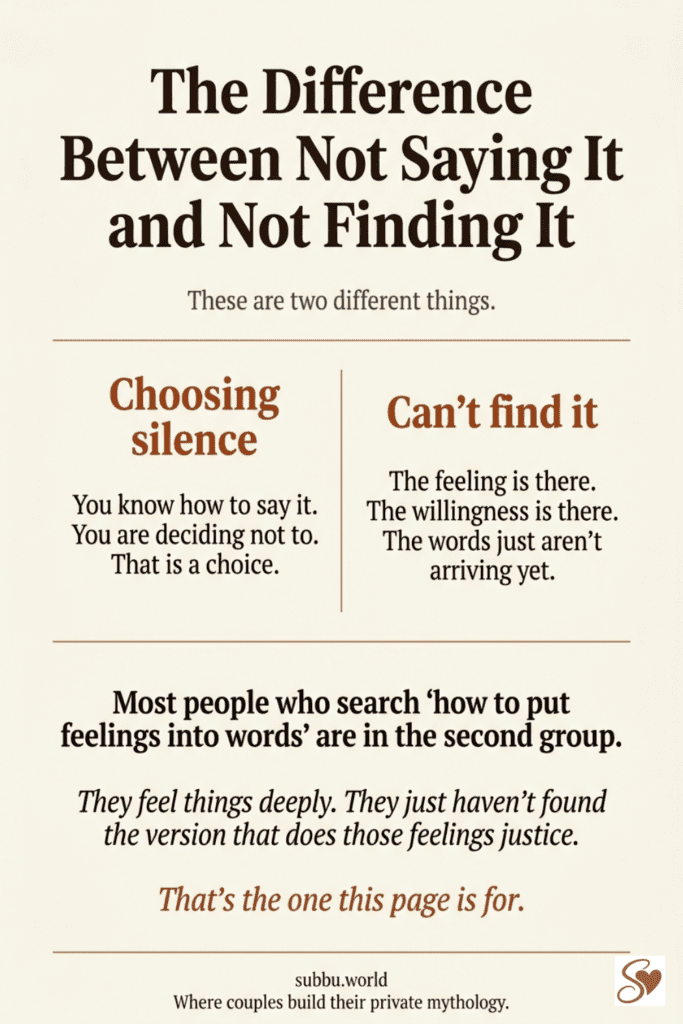
Some people don’t say what they feel because they don’t want to. They are choosing silence. That is a different thing.
But a lot of people don’t say what they feel because they cannot find the words. The feeling is there. The willingness is there. The words are just not arriving.
That second group is the one this page is for.
If you have read this far, you are probably in that group.
You feel things. You just haven’t found the version that does those feelings justice. And so you hold them. And time passes. And the moments where you could have said it get further away.
The thing is, most people on the receiving end are not waiting for the perfect version either.
They are just waiting for any version.
The trying version. The not-quite-right version. The I-wrote-this-three-times version. The I-don’t-know-how-to-say-this version.
Any of those is enough.
More than enough.
What to Do Right Now
If there is something you have been holding, here are three options.
None of them is wrong.
Option 1: Say it today, imperfectly.
Not tomorrow. Not when the moment is right. Today. With the words you currently have, which are probably better than you think they are.
Find them. Use them. Let them be enough.
Option 2: Write it first, then decide.
Get it out of your head and onto something. Paper, phone, anywhere. Not to send. Just to find. Once it exists somewhere outside you, you can figure out what to do with it.
Sometimes you will send it exactly as written. Sometimes you will find the one sentence inside it that is the thing. Sometimes you will realise writing it was enough.
Option 3: Let us help you shape it.
If what you feel is too big, too specific, or too important to risk getting it wrong, that is what Said Properly is for.
You tell us what you feel in your own words. We shape it into something beautifully designed, carefully written, and sent to them directly.
Not our version of your feeling. Your feeling, found properly.
Said Properly is coming soon. Be the first to know when it is ready.
A Note on the Things That Stay Unsaid
There is something quietly sad about a feeling that never makes it out.
Not tragic. Just sad in the small, ordinary way that things are sad when they could have been different.
The feeling was real. The person deserved to hear it. And somewhere between feeling it and saying it, something stopped.
Maybe the moment passed.
Maybe the words never came.
Maybe it felt too risky to be that honest.
I think about how many relationships have a version of this. A thing one person felt, and the other person never knew. Not because the love wasn’t there. Because the words weren’t.
That’s the whole reason Said Properly exists.
Not to write love letters. To make sure the real ones actually get sent.
Explore More
→ Things to Say to Your Partner
→ Deep Questions for Couples
→ Bonding Activities for Couples
→ Open When You Can’t Say It
→ Intimate Date Ideas
FAQs
How do you put your feelings into words?
Start at the edge of the feeling, not the middle. Instead of reaching for the big thing directly, find a specific moment where you felt it most clearly and describe the moment. The feeling comes through in the description. And if saying it out loud feels too hard, write it first. Writing removes the pressure of being watched while you look for the words.
Why is it so hard to express feelings to your partner?
Because the feeling and the words are not the same thing. You can feel something completely and still not be able to say it. Not because you do not care, but because moving a feeling from the inside to language is genuinely hard. The pressure of wanting to get it right, with someone who matters, makes the words disappear even faster.
What do you say when you can’t express your feelings?
Say that. “I have something I want to say, and I can’t quite find the right words.” That sentence lowers the pressure for both of you and opens the door for the real thing to follow. The trying is visible. And being able to see someone trying is one of the most intimate things you can witness.
How do you express love when words don’t feel like enough?
Use specificity instead of scale. Instead of trying to convey how large the feeling is, find the specific moment where it showed up most recently. “The way you did that thing last week” is more intimate than “I love you more than anything.” Specific means you were paying attention. Attention is love made visible.
What is Said Properly?
Said Properly is a service from Subbu World for the feelings that are too important to risk getting wrong. You share what you feel in your own words, and we shape it into something beautifully designed and sent to your partner. Not our words. Yours, found properly. It is coming soon. You can join the waitlist to be the first to know.
What do you do when you have feelings you can’t express?
Write them down first, even badly. Not to send. Just to find. Once the feeling exists somewhere outside you, you can decide what to do with it. Sometimes writing it is enough. Sometimes you find the one sentence inside it that is the real thing. And sometimes what you wrote is exactly what needed to be said.